
Insights


From Global to Local: Why Country Adaptations Matter
Global health economic models are powerful tools, but only when they work in the real world. For pharmaceutical companies operating across multiple markets, a single global cost-effectiveness or budget impact model is rarely enough to secure reimbursement everywhere. Each country brings its own clinical pathways, data expectations, payer priorities and HTA rules. The challenge is not how to adapt global models locally, it’s rather how to do so without diluting the value story or creating unnecessary risk.
Country adaptation is both a technical exercise and a strategic one
At first glance, country adaptation can look like a mechanical task: swap out the costs, update epidemiology, refresh thresholds. In reality, it is one of the most strategically sensitive moments in the market access journey. Local affiliate teams must:
- remain aligned with the global value narrative,
- reflect real-world clinical practice, and
- anticipate how local HTA bodies will interrogate assumptions.
Get this balance wrong, and even a strong global model can struggle locally. Get it right, and the model adaptation becomes an opportunity to strengthen the reimbursement case rather than simply localise it.
Why global models often struggle at local level
From our experience supporting country adaptations worldwide, challenges typically arise when:
- global models are not built with sufficient flexibility,
- local data requirements were not anticipated early enough, or
- adaptations are treated as “late-stage formatting” rather than early strategic inputs.
Different markets demand different levels of change, from straight forward parameter updates to more fundamental structural refinements. Recognising this early allows teams to focus effort where it truly adds value, rather than over- or under-engineering the adaptation.
What successful country adaptations have in common
While every market is different, successful adaptations tend to share a few consistent characteristics:
They start with the local question
Rather than forcing a global model into a local context, strong adaptations begin by understanding what decision-makers in that country will actually ask and what evidence they trust.
They are selective, not exhaustive
Not every parameter needs to change. Knowing which elements genuinely require localisation, and which should remain aligned globally, is critical to preserving credibility and consistency.
They anticipate scrutiny
Submission-ready models are built with transparency and robustness in mind, ensuring assumptions can withstand HTA review and downstream questions.
They protect the value story
Above all, effective adaptations reinforce, rather than fragment, the global narrative, ensuring that local decisions still reflect the therapy’s intended value proposition.
Experience makes the difference
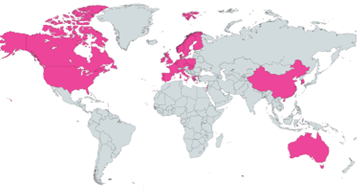
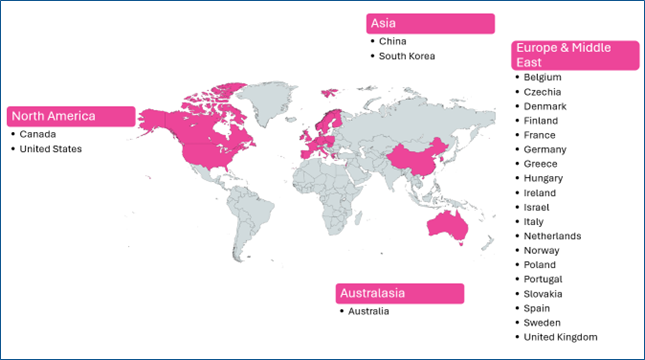
Since 2008, Symmetron has supported pharmaceutical companies worldwide with country adaptations across a wide range of healthcare systems, therapeutic areas and HTA environments (Figure 1). This breadth of experience means we understand not just how to adapt models, but when to challenge assumptions, when to simplify, and when deeper change is genuinely required.
From light-touch localisations to complex adaptations involving new evidence generation and structural refinement, our focus is always the same:

Figure 1. Symmetron economic modelling experience worldwide
Turning local adaptation into a strategic advantage
Country adaptation is often seen as a necessary step on the road to reimbursement. It is an often strategic opportunity — one that can either weaken or sharpen the case for value. Handled well, local adaptation:
- strengthens payer confidence,
- reduces downstream clarification risk, and
- supports more consistent access outcomes across markets.
Handled poorly, it can undermine even the strongest global evidence.
Final thoughts
Symmetron experts design and implement local model adaptations to provide reliable tools for decision-making. Whether through simple parameter updates or complex structural modifications, each adaptation provides an opportunity to strengthen the value story and support timely and evidence-based reimbursement decisions. If you’d like to explore how Symmetron supports country adaptations across different levels of complexity, we’d be happy to continue the conversation here.
Similar Insights







.jpg)





Stay in touch
Subscribe to Symmetron and stay up to date with recent news and announcements.


8 Devonshire Square,
London, EC2M 4PL, UK


